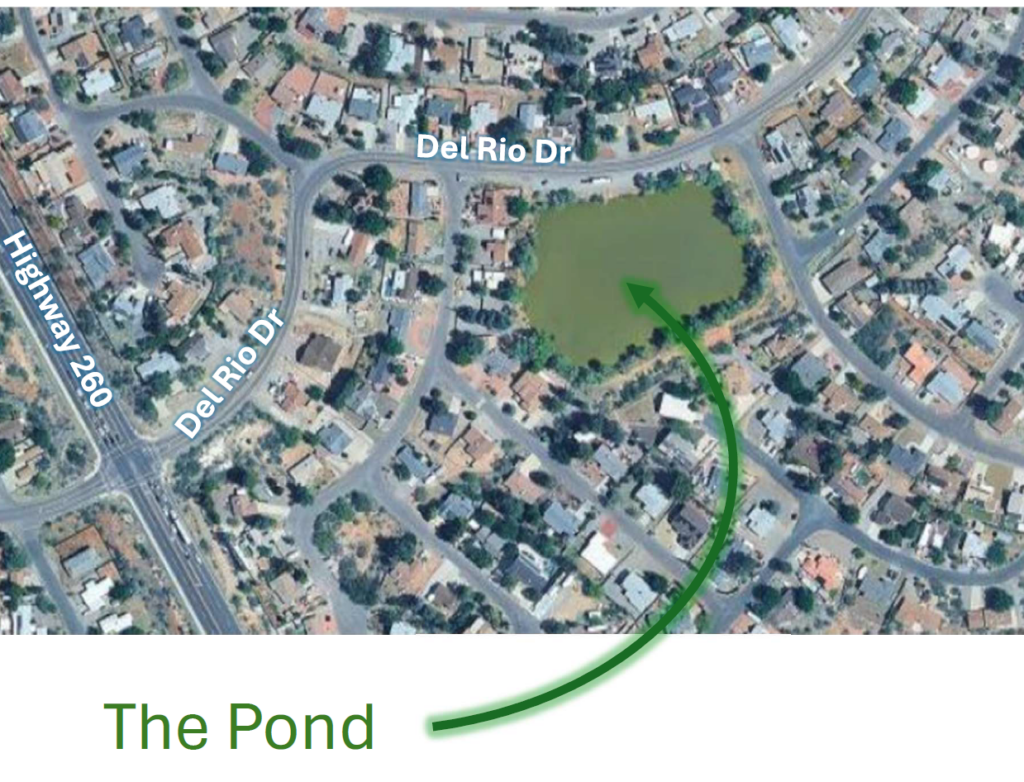
The Verde Village Community Connection
held a meeting open to the public on September 16, 2026
to inform and address concerns about the Del Rio Pond
Treasurer Jeff Rable presented a comprehensive review of the history of the pond and researched options of what to do when the water supply is cut off.
“The VVCC wishes to transform the parcel to a new community-focused use.”
Nikki Check discusses Del Rio Pond options
Sep 8, 2026 By VYTO STARINSKAS The Verde Independent
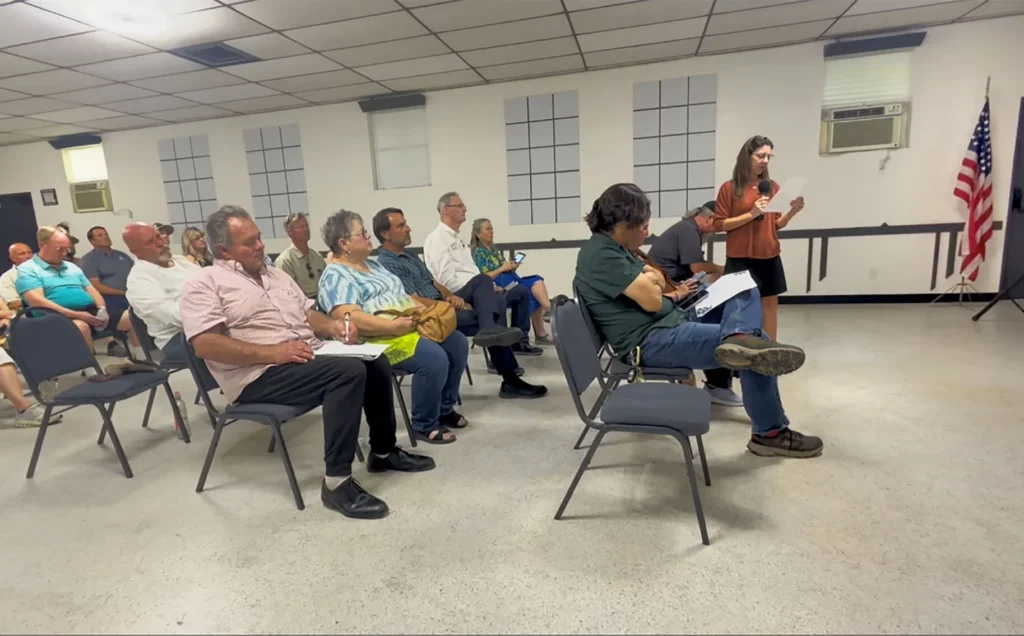
COTTONWOOD – Del Rio pond supporters met with Yavapai County Supervisor Nikki Check and Yavapai County staff during her Town Meeting on Thursday, Sept. 3, discussing the pond’s future, along with the future of its fish, fowl and turtles.
Check said the Yavapai County staff is evaluating the property owners association’s offer to take over the pond property, or whatever remains after the water is shut off. But the decision involves environmental and financial issues that have to be researched, considered and voted on by the entire board.
One suggestion was a regional park like the Windmill Park in Cornville, but a group of residents has started a recent campaign to look into saving the pond.
“I love the ducks,” Sandra Edgerton explained to Check and about 60 people attending the town hall meeting in the Verde Village’s clubhouse meeting room. “We live in a world today where a lot of things are going away.”
She said she takes books down to the lending library, kids go fishing in the pond and children have a lemonade stand there. “I am telling you, I will do everything I can do to keep this pond full of water.”
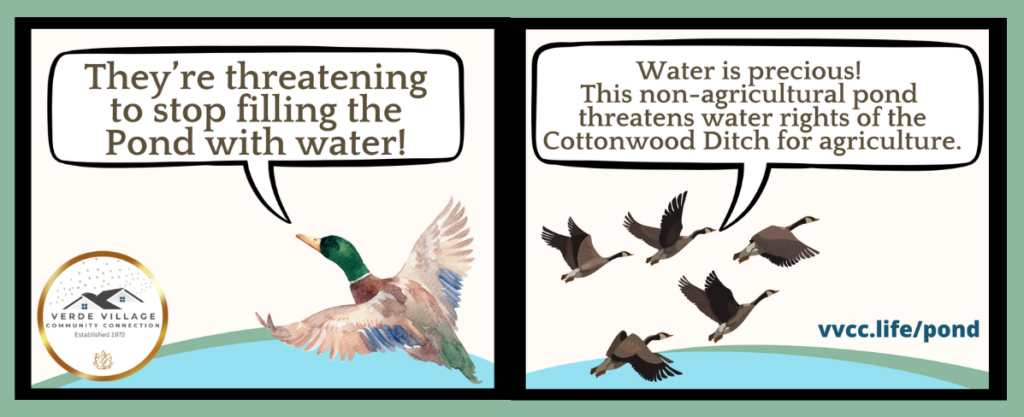
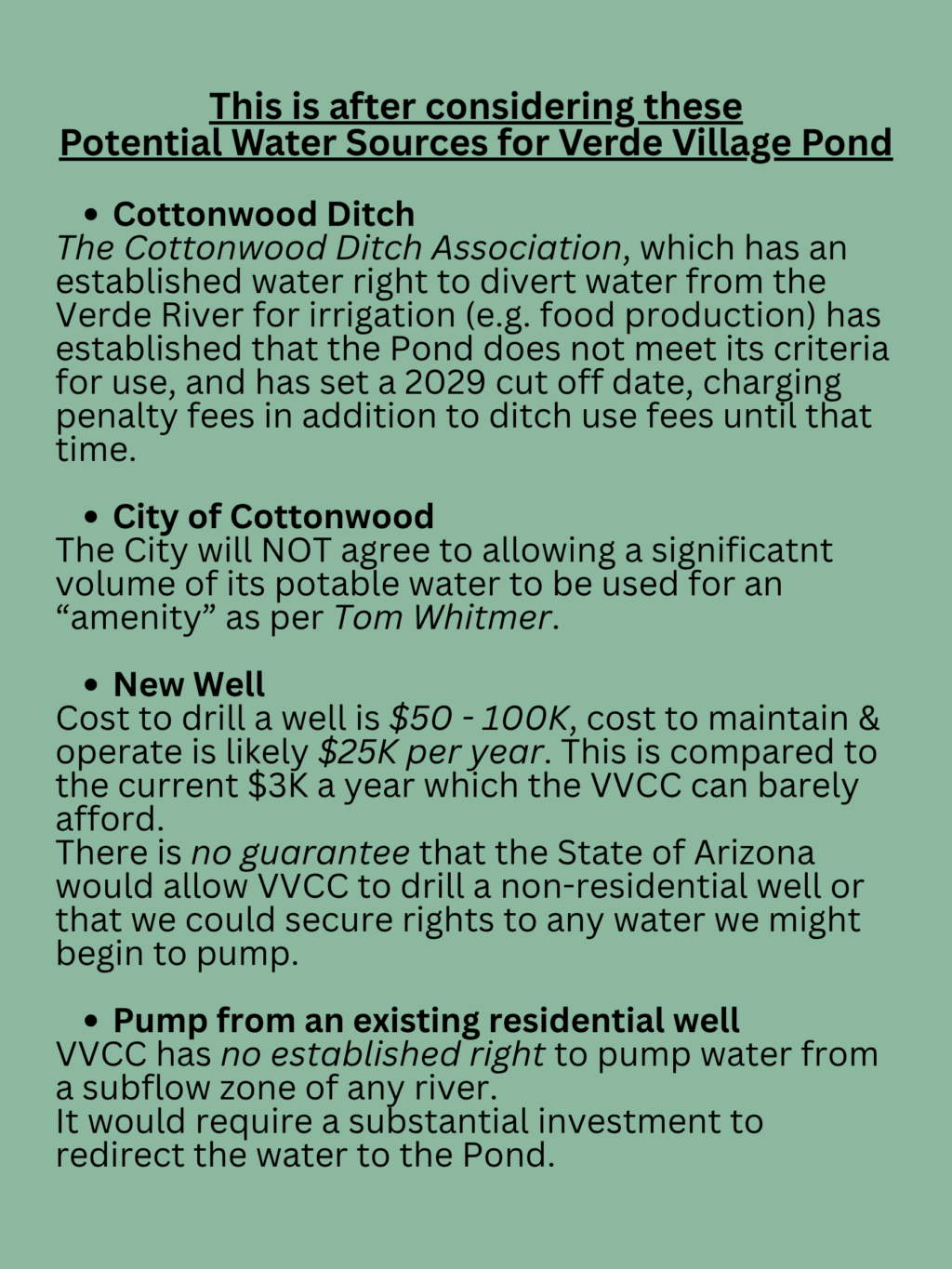
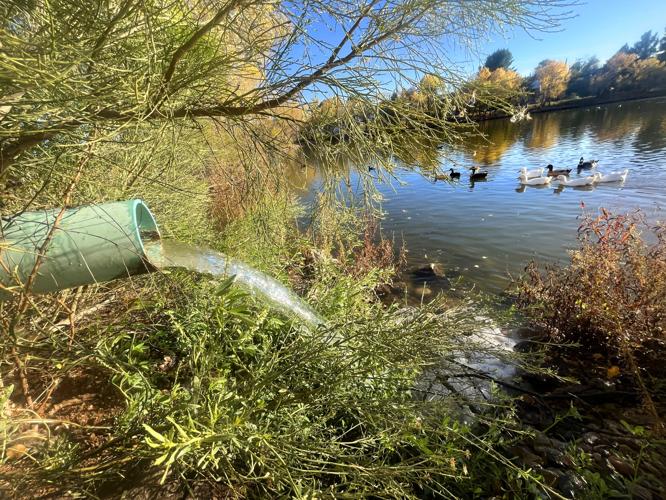
The pond needs to be drained because it relies on water from the Cottonwood Ditch, which will no longer be available after Jan. 1, 2028, because of a policy change restricting non-agricultural use.
The Yavapai County Board of Supervisors was asked to accept the pond in a donation by the Verde Village Property Owners Association on Friday, Nov. 19, 2025. The VVPOA board voted that they were no longer going to find an alternative source of water for the pond, Check said at the meeting.
“So that’s where we are today. Doesn’t mean things can’t change,” she said. The board was trying to create some certainty and direction. That’s when they started to look at moving forward without a water source.
Hypatia Traynor, spoke at the meeting representing the pond committee and said the pond has become a living ecosystem, fishing destination, and wellness area.
She said the pond was constructed to professional standards with a clay liner.
“The water source can be remedied with a well which is estimated to be a manageable cost,” Traynor said. The pond was constructed to professional standards with a clay liner.
Check said residents should contact the Verde Villages Community Connection, formerly the Verde Village Property Owners Association, with any suggestions that they have about the future of the pond.
Check said they learned, in the past year, that it’s important to engage various state agencies to get information about what opportunities the VVCC has to move forward, “with or without water in the pond.”
Check said she understood this is a “soft spot” and an asset for the community since its inception.
“My office gets a lot of inquiries on this,” Check said. She said there are people in the community coming up with alternatives and solutions, and “Yavapai County is not standing in your way.”
Residents Mull Pond’s Future
Joseph K Giddens -September 24, 2026 https://journalaz.com/2026/09/24/residents-mull-ponds-future/
Ditch Assoc. to end water supply by 2028; carp can’t be relocated
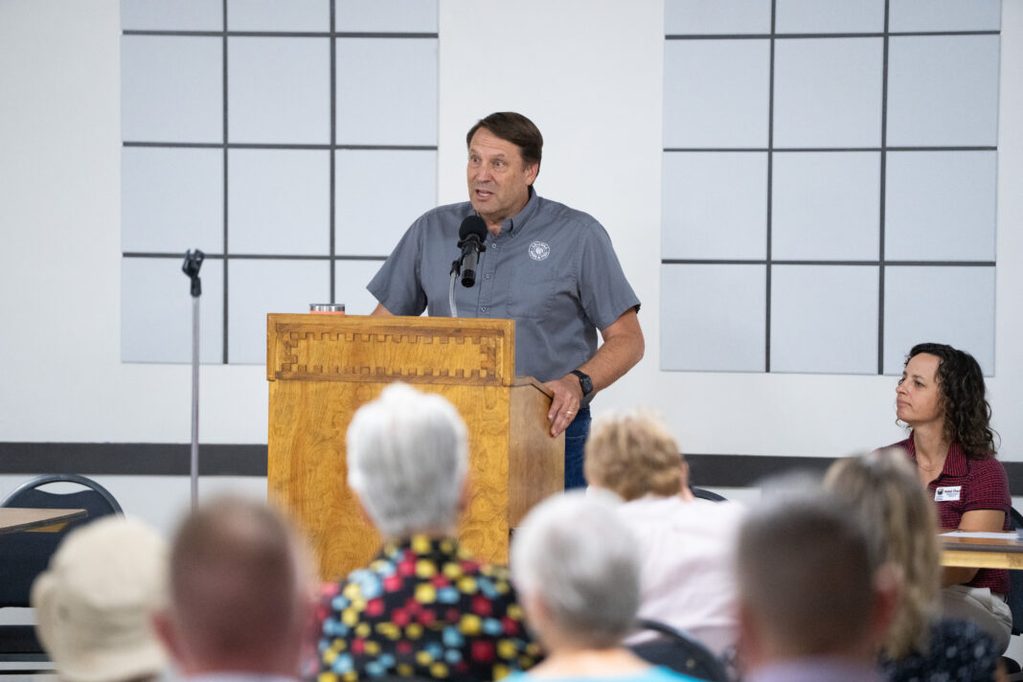
The major focus of Yavapai County’s open house on Sept. 3 was the future of the Verde Village Pond, located at 3901 E. Del Rio Drive. The pond is privately owned and maintained by the Verde Village Community Connection, formally known as the Verde Village Property Owners Association, a 501(c)(4) a volunteer-run nonprofit.
However, the pond’s water is supplied by the Cottonwood Ditch Association. To comply with state law, the ditch association approved a policy change restricting non-agricultural use that does not allow water for decorative ponds, but granted the VVCC a five-year extension for use until 2028.
On Nov. 19, the Yavapai County Board of Supervisors unanimous decided to allow county staff to investigate the process of accepting the 4.22-acre parcel with the goal of eventually making it a county park like the future Windmill Park in Cornville after the water is gone.
“The VVPOA board made a motion that did carry that they said they were no longer going to pursue options for finding an alternative source of water for the pond,” Yavapai County Supervisor Nikki Check [D-District 3] said at the meeting. “That’s when we started to engage in what’s the best way to look at things moving forward without a water source.”
Matt Chmiel, the Arizona Game & Fish Region 3 aquatics program supervisor made a brief comment to residents that the fish in the pond, the common carp [Cyprinus carpio], are not moveable because it is a species that AZGFD “doesn’t want in other locations.”
Common carp are an invasive, non-native species from Eurasia that can outcompete native Arizona fish species and can lead to water quality degradation.
“We actually remove them from other locations, so the department coming in and removing them isn’t an option,” he said. “Also, we typically wouldn’t do it on private property, so you’d want to hire somebody to remove them.”
Chmiel’s recommendation is that the community hold a fishing clinic and harvest the fish because “you can’t move them away from the pond alive.”
Moving any fish to another body of water also largely isn’t feasible because AZGFD would have to euthanize “at least 60 fish for testing to make sure they are disease-free and to ensure they are safe to move into a different body of water.”
“The best pathway forward is if the community wants to put on a fishing clinic, then you can utilize those fish so they don’t go to waste,” Chmiel said.
“I will do anything I can to keep this pond with water, I’ve lived in Arizona since 1988, and all of a sudden the water is gone,” resident Sandra Edgerton said. “But they didn’t think about that when they started building all of these homes and everything. This is a small community, but it’s a great community, and I love it here. And people are sincere, but we need to save these ducks. And I will do anything I can. I’ll go on any board, whatever you want me to do. I don’t want a park I want the ducks.”
VVCC held a follow-up discussion meeting about the pond on Sept. 16 at the Verde Village Community Center. For more information contact info@vvcc.life or call 928-646-6505.
“Community members are encouraged to review the background history and recent research on the pond at vvcc.life/pond prior to the event to help formulate their questions,” VVCC spokeswoman Cheryl Kasdorf wrote.
The VVCC Returning to Our Core Mission
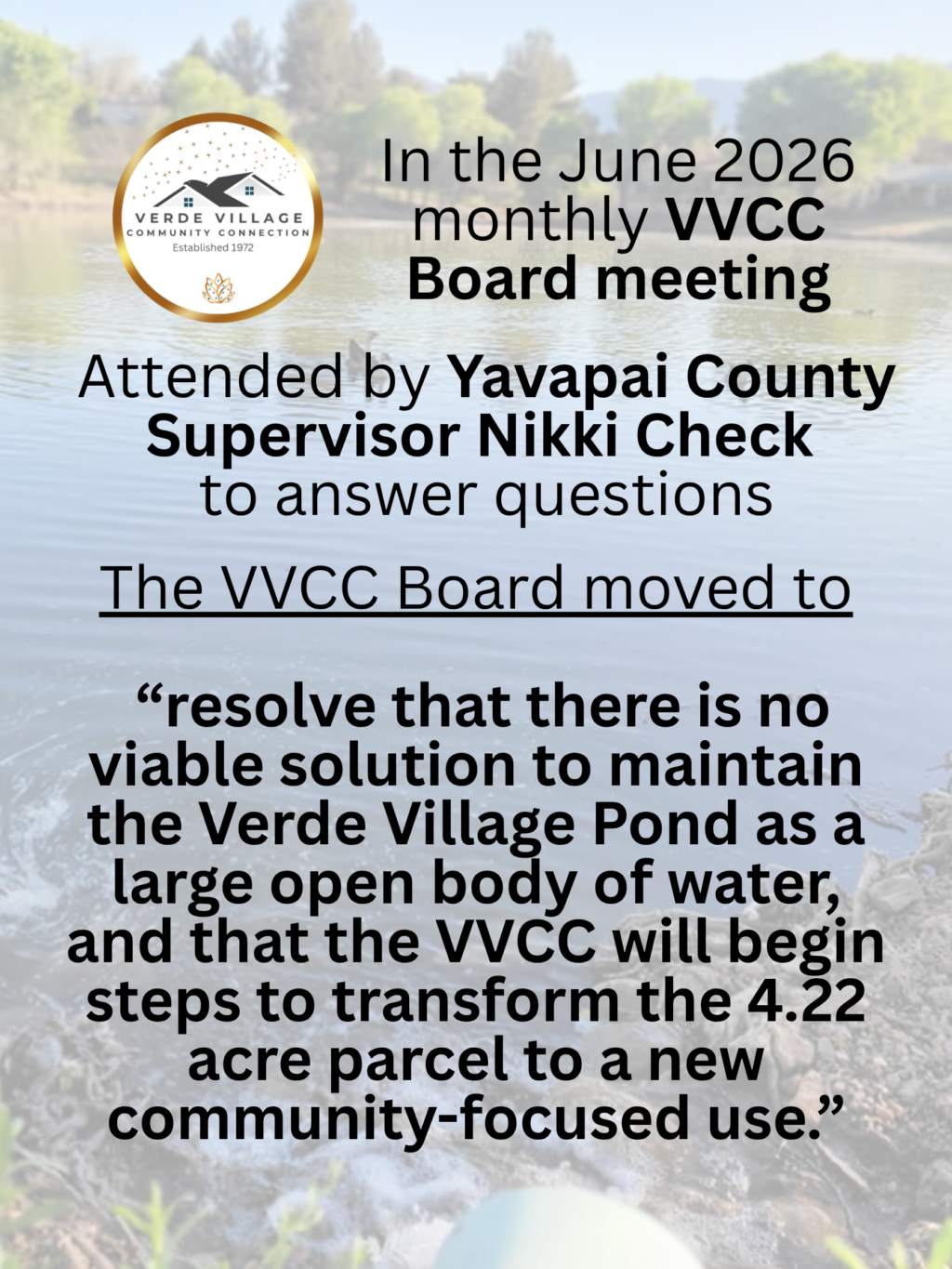
After extensive research and careful deliberation, the VVCC Board of Directors voted and resolved that no viable or sustainable solution exists to maintain the Del Rio Pond as a large open body of water.
Facing structural erosion issues and the reality of losing our ditch water supply by 2028, the financial and environmental risks of maintaining the infrastructure are simply too high.
While this marks a major change for a property owned by our nonprofit since its inception, it is important to remember our true purpose. The VVCC was never built on property or water; it was built on connecting people.
Over the years, managing complex infrastructure has inadvertently pulled our focus away from that endeavor. By beginning the steps to transform this 4.22-acre parcel into a new, community-focused use, we are finding our way back to our true mission.
We are actively exploring exciting future possibilities—including partnerships to potentially transition the area into a structured county park—ensuring this land becomes a safe, accessible, and beautiful space where neighbors can truly gather, connect, and thrive for generations to come.
The Pond’s Future: Your Questions Answered
Why Can’t We Save It as a Pond?
Saving the pond requires meeting multiple demanding conditions and finding a new water source.
- Neighborhood Impact: As a body of water without an outlet, the pond experiences seasonal algae blooms and hosts mosquitos in warm, wet seasons.
- Structural Issues: The structural integrity of the retaining walls were not designed to last this long (>50 years) without repairs. The shore is also being eroded and wildlife are contributing to its erosion.
- Cottonwood Trees: Cottonwood trees consume lots of water which needs to be continually pumped in. In addition,their pollen causes a reaction in many people
- Maintenance: The pond would require continual maintenance, which is currently beyond the capability of the VVPOA organization.
- New Water Source: See drilling a well below.
Why Can’t It Be Used for Fire Suppression Anymore?
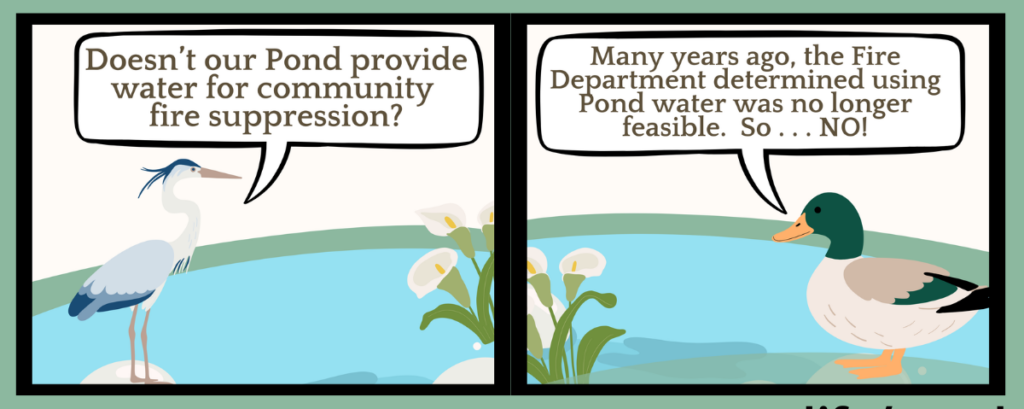
The original use as a fire reservoir is no longer feasible due to modern technology and liability concerns.
- Original Permit: A conditional use permit for the water to be used to suppress fires is what allowed the VVPOA to get shares in the use of the water from the Cottonwood Ditch Association in the 1970’s.
- Incompatible System: With the development of modern fire suppression technologies, water trucks, and fire hydrants to fill them spread throughout the Verde Village, Fire Chief Johnson says their system is not compatible with sucking water from the pond.
- For Wildfires: In terms of using a helicopter to dip water out of the pond for wildfires, Fire Chief Johnson says that the liability is too great considering the surrounding homes and wildlife.
Why Can’t We Drill a Well to Supply Water?
Drilling a well is expensive, legally complex, and would not guarantee a long-term solution.
- High Cost: The cost of drilling a well would be $50,000 to $100,000. This volunteer nonprofit does not have the money, nor does it have the right status to apply for grants.
- Water Rights and Permits:
- The VVPOC may not have Water Rights to dig a well for non-residential purposes.
- It may not be possible to get a permit to do so for a recreational purpose with the emphasis on water conservation.
- It is no longer legal to drill below the water table to obtain water.
- Risk of Shut-Off: With AZ water litigation continuing, if a well was drilled, it would not be assured to continue pumping if there was a decision against it from the state.
- Infrastructure: If the pond continues to be filled with water from a well, the infrastructure would have to be improved to continue to hold the water safely.
Why Can’t It Be a Wildlife Refuge or for Agriculture?
Both options face challenges with funding, water supply, and organizational capacity.
Endangered Wildlife Refuge and Environmental Conservancy
- Funding Challenge: The primary challenge is where the water and the money to support the water come from.
- Grant Ineligibility: As the VVPOA is a 501(c)4 non-profit, it is not eligible for grants normally given for these kinds of projects.
Agriculture
- Business Management: Someone would have to step forward to manage the agriculture as an entirely new business.
- Tax/Expertise: In order to do that, a special water district would have to be assembled that would impose a tax on all the homes in the Verde Village. This kind of expertise is beyond any current volunteer’s capability.
What About Turning the Area Into a Park or Splash Pad?
Both alternatives would require extensive construction, engineering, and funding that the VVPOA cannot cover.
Park
- Site Preparation: The water would have to be removed and the pond area filled in with dirt. If engineers with know-how could direct this, it might be possible with free dirt.
- Water: Unlesswe create a park that strictly has ‘native plants,’ we still have the issue of providing water.
- Funding: The improvement into a park would be dependent on funding sources, which is not in the scope of the VVPOA budget. In addition, currently there are not the people or resources to fund-raise.
Splash Pad
- Property Issues: First, there are all the issues with the property such as fortifying the retaining walls, filling in the depth, and landscaping it. Then there is the issue of engineering and design of the facility.
- Water Sourcing: Sourcing water from City of Cottonwood pipes would involve getting a meter installed and paying a water bill such as residents do.
There are a multitude of ways to get involved, such as:
- * Visit the pond and enjoy it between dawn and dusk
- * Volunteer to help cut and remove brush and pick up trash around the pond
- * Inform neighbors and friends of the issues with the pond
- * Donate money to help pay for current expenses such as electricity to run the pump and Cottonwood Ditch fees
- * Become a VVCC member to help shape its future
- * Donate money to implement short-term remediation solutions
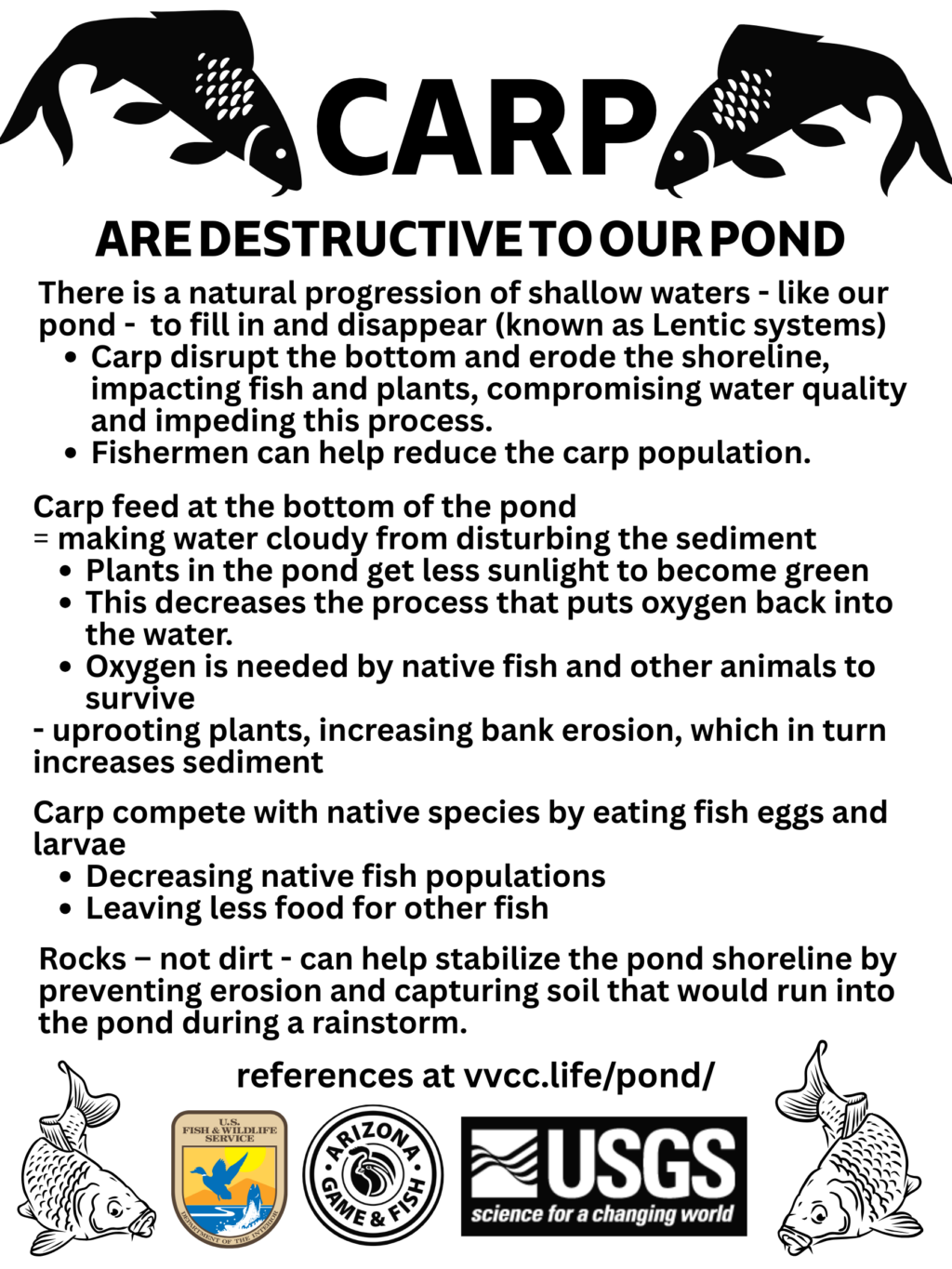
Carp compete with native species by eating fish eggs and larvae, decreasing native fish and leaving less food for other fish.
- Invasive Species We Study: Invasive Carp | U.S. Geological Survey
- Invasive Carp in North America
- Seven Wild Ways Scientists Are Trying to Stop Invasive Carp
- Ecological-Risk-Screening-Summary-Common-Carp.pdf
The common carp is listed under Additional influential species in this document. It describes the natural progression of shallow waters like our pond to fill in and disappear as a Lentic System. The carp disrupts this process.

Dog poop is a serious threat to water quality, Plastic bags are available at the pond to pick up poop if you have forgotten yours.
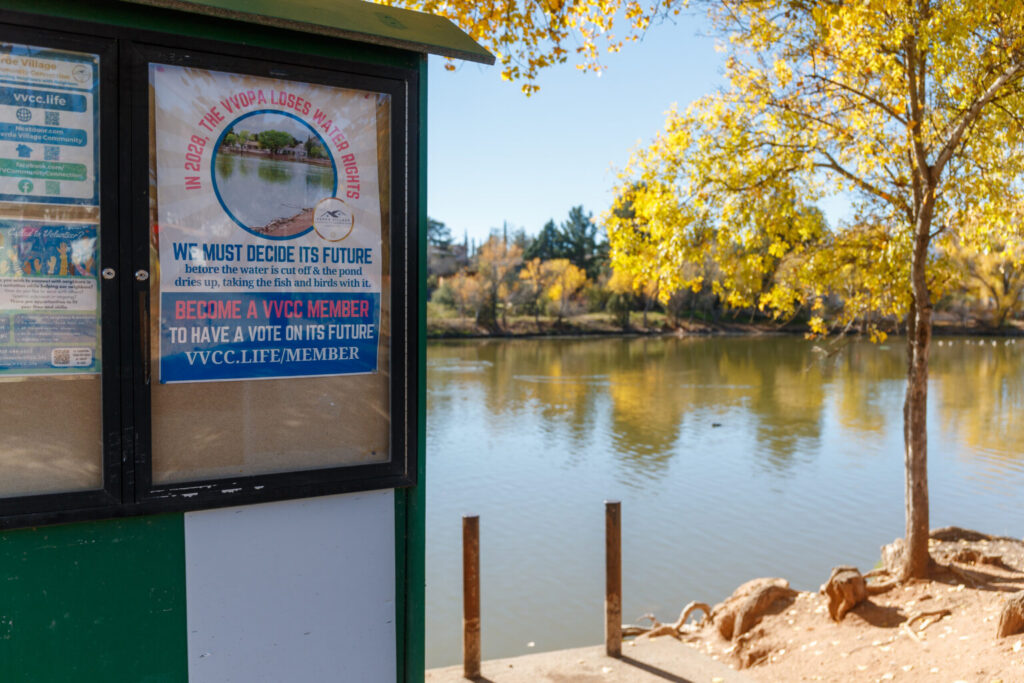
Verde Village Pond could be dry by 2028
– Christopher Fox Graham, Larson Newspapers
(published June 18, 2025)
Arizona water rights litigation is affecting the Verde Valley, and the Verde Village Community Connection is seeking a solution regarding a 2028 deadline that will potentially interfere with the future water replenishment for the three-acre Verde Village Pond located in Verde Village Unit 4.
The pond is privately owned by the Verde Village Property Owners Association, a 501(c)(4) nonprofit doing business as the VVCC. The VVCC will lose its water rights to the pond by 2028, which VVCC leadership stated necessitated a decision on the pond’s fate to prevent it from drying up and affecting local waterfowl and wildlife.
The pond, a landmark in the Verde Village, was originally established during the Unit 4 subdivision’s development as an attraction and for fire suppression.
While the Verde Valley Fire District and Cottonwood Fire Department fire trucks can now draw water from municipal hydrants, the 12-foot-deep pond remains a wildlife habitat and recreational spot enjoyed by fishermen, picnickers, and birders.

Verde Village to donate pond to county
By VYTO STARINSKAS, The Verde Independent 12/6/2025
VERDE VILLAGE – The Verde Village Property Owners Association wants the county to take over the Verde Village pond and make it a regional park, and the Yavapai County Board of Supervisors has advanced the plan.
Aislinn Maldonado, president of the VVPOA, said a park would be an amazing way for the community to move forward, and they have tried everything else.
The Yavapai County Board of Supervisors was asked to take the pond in a donation by the VVPOA on Friday, Nov. 19.
Verde Village Pond may become a park
By Joseph K Giddens -December 15, 2025
The Verde Village Pond, located at 3901 E. Del Rio Drive in Verde Village Unit 4, could one day be drained and converted into a county park following the Yavapai County Board of Supervisors’ unanimous decision to allow staff to investigate the process of accepting the 4.22-acre parcel on Wednesday, Nov. 19.

Waterfowl
The Del Rio Pond hosts a wide variety of ducks and geese and migrating birds stop by seasonally.
It is said that ducks prefer the pond to Dead Horse State Park lagoons because the pond is murky and the lagoons are too clean.
Over the years, domestic ducks have been dropped off at the pond by people who no longer wanted them. They could not support themselves and volunteers would feed them. They could not fly away because they are domestic, and have interbred with wild ducks, making a hybrid that also cannot support itself.
In 2024, volunteers were able to remove and rehome all the domestic ducks, leaving only the wild ones.


Fish in the Pond
Fishermen catch a wide variety of fish in the pond, yet carp and catfish are predominant. The pond was stocked with fish in the far past.
Since the pond is private property, no fishing license is required to fish here.
Visitors are welcome to fish dawn to dusk, the hours the pond is open to the public.
In 2023, the VVCC sponsored a catch-and-release Youth Fishing Tournament. Participants did not pay a fee to enter, and competed for prizes for Most Fish Caught, Largest Catfish, and Largest Carp. See photos of the tournament at vvcc.life/2023-events.
Understanding Surface Water Rights

The Verde Valley has a rich history of agriculture that continues to this day. Farms and ranches of various sizes dot the landscape. Some who own property in the Verde Valley keep animals, tend gardens or farms, and irrigate lush lawns and large trees. But landowners and potential landowners—especially those looking at irrigated properties—should be aware of some basic laws regarding water rights.
Just because a property does irrigate may not mean it has the legal right to do so or that the use will be recognized in the future. For many reasons, there remains uncertainty about the use of surface water from creeks and rivers and even well water on properties throughout Arizona. By understanding some of the basic laws around surface water, you should be able to better evaluate risks and uncertainties associated with a particular water use.
Download the pdf “Surface Water Rights” from the Cottonwood Ditch Association website for more detailed information.
See the letter sent the VVPOA from the Cottonwood Ditch Association here and their 2024 Annual Meeting Minutes here.
FOR MORE INFORMATION ABOUT WATER IN ARIZONA AND THE VERDE VALLEY:
Arizona Department of Water Resources: azwater.gov
Friends of the Verde River: verderiver.org
Salt River Project: WatershedConnection.com
Superior Court General Stream Adjudication page: http://www.superiorcourt.maricopa.gov/SuperiorCourt/GeneralStreamAdjudication/Index.asp